Stop 05 · Tailoring Fit Notes
Trouser Break: Choosing Between None, Slight, and Full
A quarter inch of hem decides whether your trousers look pressed or puddled, and the right break depends on your leg opening and your shoes.
By Julian Okafor, Tailoring Editor
· 6 min read · 1,315 words
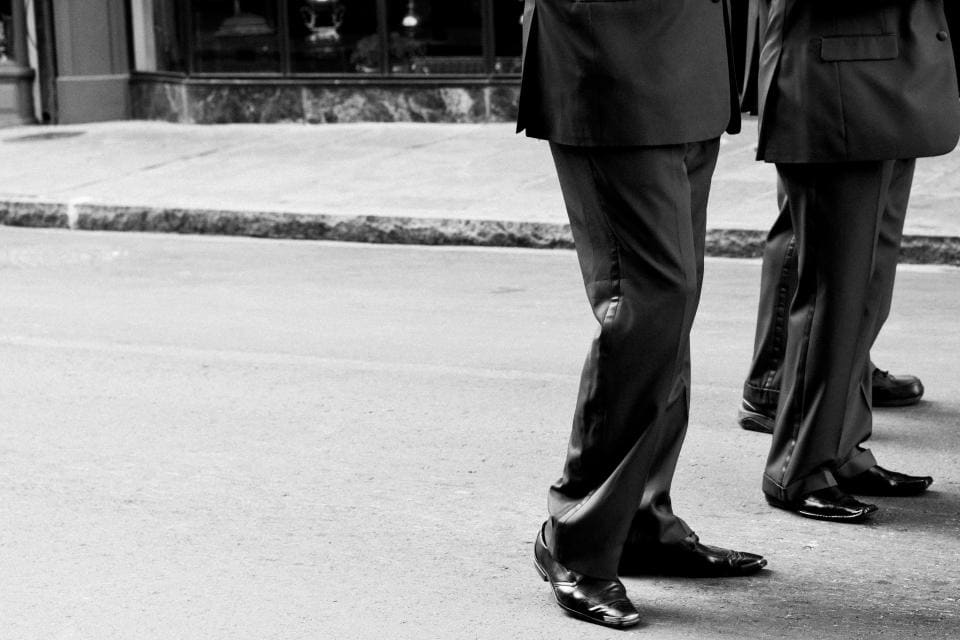
How much break do you want? Every tailor asks some version of it, usually while you’re standing in your socks on a carpeted box, and most men answer “a little” because it sounds reasonable. He then pins the hem against the box, which isn’t a shoe, and you go home with trousers that look fine in the fitting room and slightly wrong everywhere else. I pinned hundreds of those hems from the other side, and I learned to distrust any answer that arrived without shoes.
Trouser break (pant break, on most shopping sites) is the fold that forms where your hem meets your shoe. For most suit and dress trousers the right answer is a slight break: about half an inch of hem resting on the shoe and one shallow dimple at the front. Go to no break only on a leg opening of 7 1/2 inches or less, and to a full break only on wide trousers of 8 3/4 inches and up.
A break is a fold you can measure
Break isn’t a length in itself. It’s what happens when a length meets a shoe at a particular leg width. The same trouser hemmed to the same inseam will show no break over a low loafer and a slight one over a taller lace-up, because the shoe pushes the hem up by a different amount. A low sneaker catches even less, which is why hemming chinos for sneakers follows its own rules.
So the tailor’s one question is really three: how long the hem is in front, how much it slopes toward the back, and how wide the leg opening is. A narrow opening can’t hold extra cloth gracefully, so it stacks and wrinkles. A wide opening can absorb a full fold and still fall straight. Most of the bad hems I’ve seen came from treating the first question as the only one.
| Break | Front hem on the shoe | Best leg opening |
|---|---|---|
| None | Grazes the top, no fold | 7 to 7 1/2 inches |
| Slight | About 1/2 inch, one shallow dimple | 7 1/2 to 8 1/4 inches |
| Medium | About 1 inch, one clear fold | 8 to 8 3/4 inches |
| Full | 1 1/2 inches or more, deep fold | 8 3/4 inches and up |
Leg opening here is measured flat across the hem, so double it for the circumference. If you don’t know yours, lay the trousers on a table with a tape measure. It takes ten seconds and tells you most of what you need.
No break puts your socks on display
A trouser with no break ends just at the top of the shoe and hangs in one clean line from knee to hem. On a slim, tapered leg it looks sharp, and it makes a short man look slightly taller because nothing interrupts the line. It also shows your socks every time you sit, walk briskly, or climb a stair. Wear no break and your socks become part of the outfit, so give them the attention you’d give a tie; choosing socks by fiber is a good place to start.
The other cost is a thin margin for error. Trousers shrink a little in the first few dry-cleanings and ride up when you sit, and a hem cut to the very top of the shoe has nowhere to go. I’d only cut a no-break hem on an opening of 7 1/2 inches or less, with the back angled about half an inch longer than the front so the heel doesn’t look exposed.
Slight trouser break is the safe default
A slight break, roughly half an inch of hem on the shoe, is what I recommend to nine men in ten. It suits the leg openings most suit and dress trousers are cut with, about 7 1/2 to 8 1/4 inches. It covers your socks while you stand, survives a little shrinkage, and looks deliberate without looking fussy.
If you can’t decide, choose slight, because it’s the only break that forgives a mistake in either direction.
It’s also the break that sits best on a sleek dress shoe. I usually hem suit trousers against a closed-laced oxford like the Allen Edmonds Park Avenue Cap-Toe Oxford ($425). Its low, clean profile gives the hem a flat place to land, and because it’s Goodyear-welted and can be recrafted when the sole is done, the hem stays right for years. The limitation is real, though. It’s too formal for jeans or chinos, so it’s the wrong shoe to bring when you’re hemming casual trousers, and the leather sole is slick on wet pavement for the first few weeks. I scuff new soles on a rough sidewalk before trusting them in the rain, and if your commute is mostly wet, read up on leather and rubber soles for commuting before you buy.
Full break belongs to wide trousers
A full break, an inch and a half or more of cloth folding over the shoe, carries a bad reputation from the era of baggy suits that pooled at the ankle. On a narrow trouser it earns it. The extra cloth has nowhere to go, crumples into two or three folds, and makes you look shorter and borrowed.
On a genuinely wide trouser, with an opening of 8 3/4 inches or more and usually a pleat or two at the waist, a full break is correct. The weight of the extra cloth keeps the leg falling straight, and the fold reads as drape. Winter flannels carry it especially well (heavier cloth hangs better at the hem, one of several reasons suit fabric weight matters), and a cuff of 1 1/2 to 1 3/4 inches adds weight that helps the hem sit. Slim trousers, skip it. Wide trousers, commit.
Medium break, about an inch of overlap and one clear fold, is what most off-the-rack trousers end up with when a store hems them to a standard inseam. On a straight leg of around 8 1/2 inches it’s perfectly respectable, and it’s the safe choice for trousers you’ll wear with both shoes and boots. On anything slimmer it looks like a slight break that missed by half an inch, which is usually exactly what it is.
Bring the shoes
Most of what goes wrong with a hem happens because the trousers were pinned without the right shoes, or with none at all. A dress oxford, a loafer, and a boot each sit differently on the foot, and the difference at the instep can be more than half an inch. Bring the shoe you’ll wear most with those trousers (if you aren’t sure which that is, pairing shoes with a suit will settle it), and stand naturally. Don’t look down while the tailor pins. Your posture changes and the hem moves with it.
Ask for the hem to be angled, the back roughly 1/4 to 1/2 inch longer than the front, so it reaches the top of the heel while the front sits on the instep. A plain hem at most shops costs $15 to $25 and a cuffed hem $25 to $40. Ask for about 1 1/2 inches of extra cloth to be left folded inside, so the trousers can be let down later. I learned that one on my own gray flannels, cut for no break and a quarter inch shorter after their first trip to the cleaner. More fixes like it live in our tailoring fit notes.
The verdict: Ask for a slight break, about half an inch of hem on the shoe, on any trouser with a leg opening between 7 1/2 and 8 1/4 inches, which is most of them; keep no break for openings of 7 1/2 inches or less and full break for openings of 8 3/4 inches and up. Bring the actual shoes to the fitting, ask for an angled hem, and pay the extra $10 to $15 for cuffs only on heavier, wider trousers.
In this story
How we make money: some links below are affiliate links. If you buy through them, Via may earn a commission. It never changes the price you pay, and it never decides what we recommend. Full disclosure.
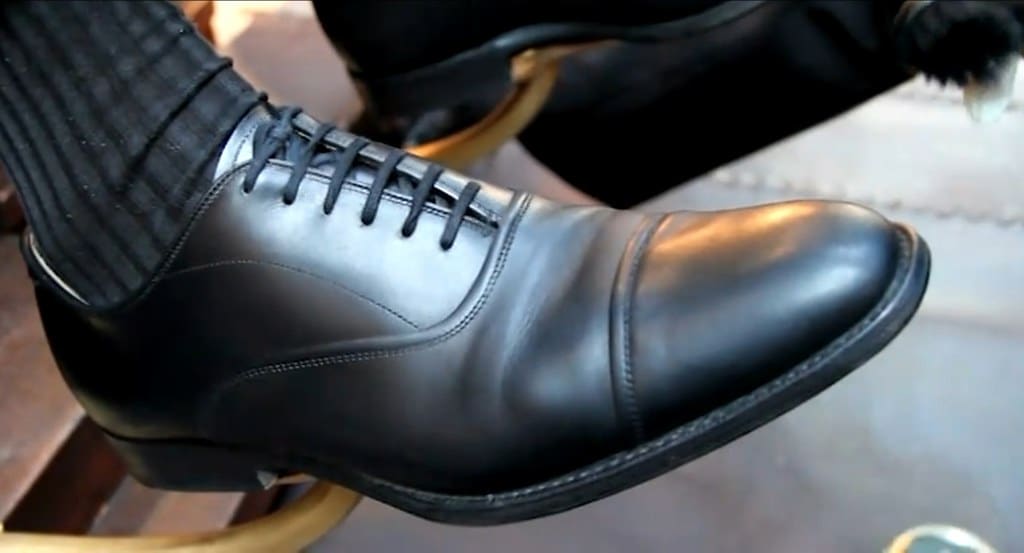
Investment · $300+
Allen Edmonds Park Avenue Cap-Toe Oxford
A Goodyear-welted calfskin cap-toe oxford with a closed lacing that sits clean under suit trousers and can be recrafted by the maker when the sole is done.
Won't do: Too formal for jeans or chinos, and the leather sole is slick on wet pavement for the first few weeks.
Next stops
All Tailoring guides
Suit Fabric Weights: Ounces, Seasons, and Wrinkles
The weight of the cloth decides when you can wear a suit, how it hangs, and whether it looks slept-in by lunch, so learn the numbers before you shop.
Julian Okafor 7 min

Matching Shoes to Suits Without a Color Wheel
Two rules cover nearly every suit you'll own: shoes darker than the suit, and sleeker as the occasion gets more formal.
Julian Okafor 6 min

Wedding Guest Dress Codes, Decoded for Men
From black tie to beach, here is what each line on the invitation actually asks of you, planned the Via way: shoes first, then everything above them.
Sam Whitaker 9 min